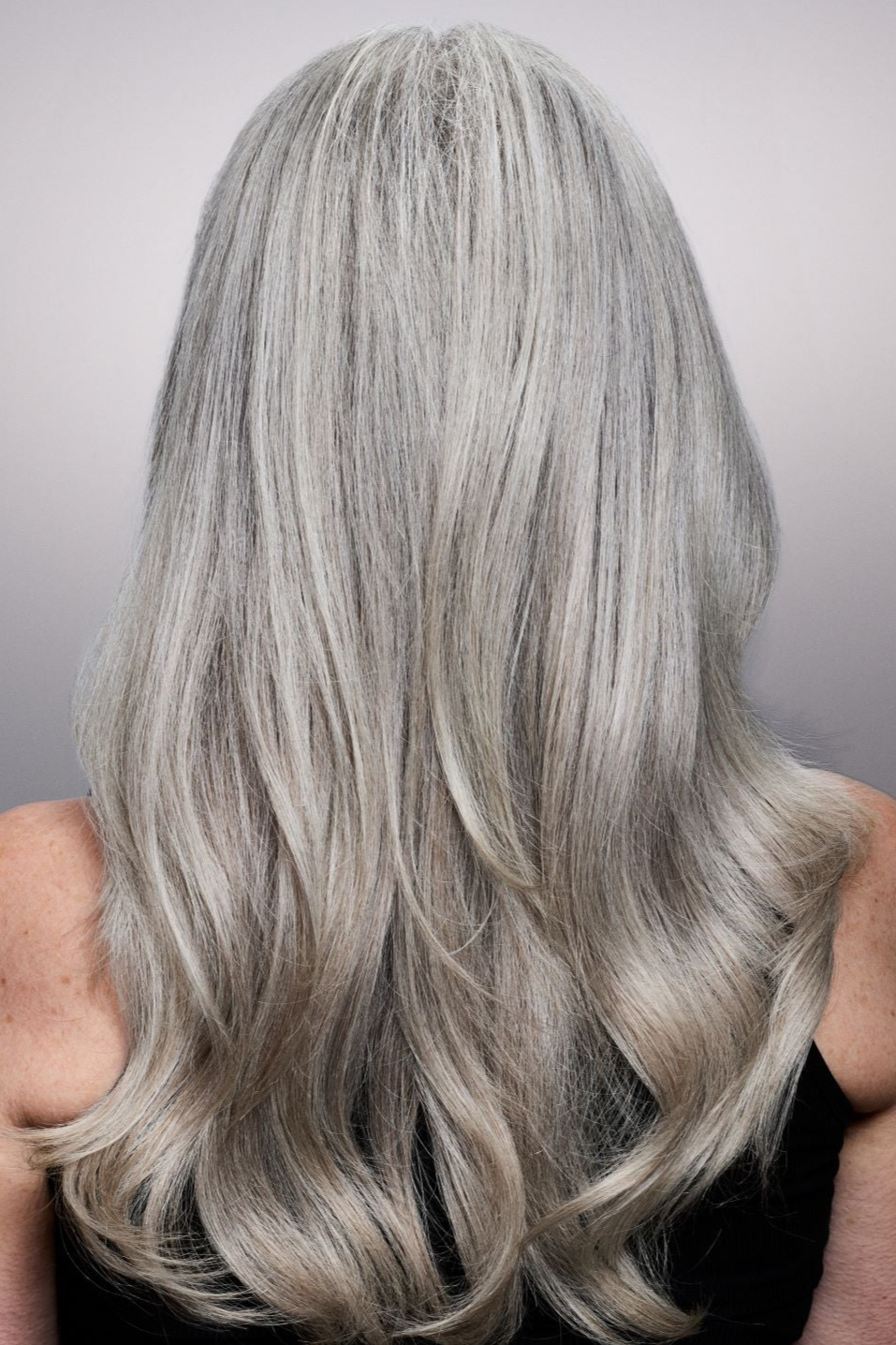

What Your Gray Hair Is Telling You
Gray hair has a way of making every change visible.
A little warmth that might have disappeared into brown or blonde hair suddenly looks yellow. A bit of product buildup can read as dullness. A rough patch near the ends can feel like proof that your texture has changed overnight. And before long, the question becomes: Is this brassy gray hair? Dryness? Damage? Or is this just what gray hair does?
The honest answer is: it depends.
Natural gray, silver, and white hair are not simply darker hair with the color removed. When hair loses melanin, it changes the way it interacts with light, moisture, heat, and the environment. That does not mean gray hair is inherently problematic. It means it is more revealing. It shows what is happening to it.
So before reaching for the strongest purple shampoo, booking a corrective treatment, or deciding your hair has become “coarse,” it helps to understand what you are actually seeing and feeling.
Note: Some gray hair naturally grows in with warmer, creamier, or more blonde tones depending on your original hair color.
Think of this as a field guide for reading your silver hair.
First, gray hair is not really gray
The word “gray” is useful shorthand, but technically, gray hair is often translucent or white hair mixed with pigmented strands. The appearance of “gray” comes from the way those depigmented strands mingle with darker, warmer, or cooler hairs around them.
That translucency is part of what makes silver hair so striking. It catches light. It reflects tone. It creates dimension that cannot really be replicated by dye.
But translucency also makes gray hair more visually sensitive. A yellow cast, mineral deposit, heat stain, or layer of buildup has nowhere to hide.
On pigmented hair, some of that visual noise gets absorbed or camouflaged. On silver hair, it can show up quickly.
If your brassy gray hair looks yellow or warm

Yellowing is one of the most common concerns for people with natural gray hair, and it is also one of the most misunderstood.
The first instinct is often to call it brassiness. But “brassy gray hair” is a broad description. It can refer to warmth from actual discoloration, minerals sitting on the hair, product buildup, or simply the way your natural silver reflects against remaining pigmented strands.
True yellowing in gray hair can be caused by several things:
- UV exposure
- heat styling
- hard water minerals
- chlorine
- pollution
- product buildup
- overuse of pigmented toners
- smoke or environmental residue
Because gray hair lacks melanin, it has less natural visual protection from these external stressors. Melanin does not just create color; it also helps absorb and diffuse some environmental damage. Without it, yellow tones can become more visible.
Heat is a particularly important culprit. High temperatures from flat irons, curling irons, and blow dryers can contribute to discoloration, especially on lighter silver and white strands. The effect is similar to what happens when a white cotton shirt is exposed to too much heat: the mark is not purple or orange. It is yellow.
Hard water can create a different kind of yellowing. Minerals such as iron, copper, calcium, and magnesium can cling to the hair and leave it looking dull, dingy, or warm. This is not the same thing as naturally warm undertones, and it may not respond well to toning alone.
That distinction matters. If the issue is mineral buildup, adding more pigment may temporarily mask the warmth, but it will not address the residue.
If your brassy gray hair looks dull but not exactly yellow

Dullness in brassy gray hair is often mistaken for brassiness alone.
Silver hair depends on light reflection. When the cuticle, the outermost layer of the hair, lies smoothly, light bounces off the strand more evenly. That is what creates shine. When the cuticle is raised, coated, dry, or uneven, light scatters instead. The result can look flat, smoky, beige, or muted.
This is where many people misread their hair.
If your gray hair looks less luminous but not clearly yellow, the problem may not be tone at all. It may be buildup, dryness, or cuticle roughness.
A few clues:
- If your hair feels coated or heavy, think product buildup.
- If your hair looks flat shortly after washing, think buildup or hard water.
- If your ends look matte and rough, think dryness or cuticle wear.
- If your hair looks dull only in certain lighting, think reflection, not necessarily discoloration.
This is why “more toning” is not always the answer. Sometimes what gray hair needs first is a clean surface, better moisture balance, or gentler styling habits.
If your gray hair feels dry, rough, or wiry

There is a persistent myth that gray hair is automatically coarse. Many people describe their silver strands as wiry, stubborn, or rough, especially during the transition from dyed hair to natural gray.
But the story is more nuanced.
Gray hair can feel different for several reasons. As hair loses melanin, the strand may become more porous and more vulnerable to moisture loss. At the same time, scalp oil production often decreases with age, which means less natural sebum travels down the hair shaft. That matters because sebum is one of the body’s built-in conditioning systems.
So the “coarse” feeling may not mean the hair itself is thicker or worse. It may mean the strand is drier, less lubricated, or more exposed.
There is also the dye factor. For years, permanent color can coat, swell, or alter the hair, creating a familiar texture. When someone stops dyeing, the natural texture that emerges can feel unfamiliar, not necessarily because it is bad, but because it is no longer being disguised by color deposits and chemical processing.
For some people, going gray also reveals a wave pattern or curl pattern they did not realize they had. What gets labeled as frizz may actually be texture asking for different care.
A better question than “Why is my gray hair so coarse?” might be: Is my hair actually coarse, or is it dry, porous, under-conditioned, or being compared to dyed hair?
That shift changes everything.
If your hair grabs color or toner unevenly

Another clue lies in how your hair responds to pigment.
Gray and lightened hair can behave like a “super soaker” for color because lighter, more porous strands may absorb pigment quickly. This is why some people use a purple shampoo once and end up with lavender patches, smoky ends, or uneven tone.
Gray and lightened hair can behave like a “super soaker” for color because lighter, more porous strands may absorb pigment quickly.
Porosity is not always uniform across the head. Ends are usually older and more weathered than roots. Hair around the face may be more exposed to sun, heat tools, sunscreen, skincare, and environmental residue. Formerly dyed areas may behave differently than newly grown natural silver.
That means the same toner or shampoo can land differently from section to section.
If your hair over-grabs toner, this could indicate that your hair is more porous in certain areas.
If your brassy gray hair keeps turning yellow
Recurring yellowing is a sign to look beyond tone.
Ask:
- Do you use hot tools frequently?
- Are you using heat above 350°F?
- Do you have hard water?
- Do you swim in chlorinated pools?
- Are your styling products leaving residue?
- Are you using purple shampoo too often?
- Do you spend a lot of time in the sun?
- Are your ends older, more porous, or previously color-treated?
Gray hair care is often treated as a color-correction problem, but yellowing can be a lifestyle and environment problem. If heat or minerals are causing the issue, toning can help visually, but prevention matters more.
Gray hair care is often treated as a color-correction problem, but yellowing can be a lifestyle and environment problem. If heat or minerals are causing the issue, toning can help visually, but prevention matters more.
This is especially true with heat. Once hair has been structurally damaged, it cannot be permanently “repaired” back to virgin condition. It can be improved cosmetically to look and feel smoother, shinier, more manageable, but prevention is the better strategy.
That does not mean giving up styling. It means using lower heat when possible, avoiding repeated passes with hot tools, letting hair dry more before applying direct heat, and protecting the hair from daily stressors.
When purple shampoo helps brassy gray hair—and when it does not
The majority of the “gray hair” products in the market are purple shampoos that include a high load of purple pigments. Purple shampoo has a place. It works through basic color theory: purple sits opposite yellow on the color wheel, so it can help visually neutralize yellow tones.
But purple shampoo is not a universal gray hair solution, especially because it was developed originally for treating color-processed blonde hair, which easily becomes brassy/yellow in appearance without constant toning.
It can be especially helpful for hair that has been processed and requires deeper and frequent toning. It may be less helpful when the issue is:
- Natural mixed gray patterns without processing
- Hard water buildup
- Heat damage
- Product residue
- Dryness
- Dullness
- Uneven porosity
- Hair that is already over-toned
Used too often, strong purple shampoos can leave gray hair looking flat, smoky, violet, or even darker. They can also be drying, depending on the formula.
The goal is not to fight silver hair into submission. The goal is to understand what the hair is asking for.
Sometimes it asks for tone correction. Sometimes it asks for moisture. Sometimes it asks for a clarifying reset. Sometimes it asks for less heat.
A simple way to read brassy gray hair

If your hair looks yellow, consider UV, heat, hard water, chlorine, or environmental exposure.
If your hair looks dull, consider buildup, dryness, or a raised cuticle.
If your hair feels rough, consider moisture loss, reduced scalp oils, porosity, or styling stress.
If your hair looks unevenly toned, consider porosity differences between roots, ends, face-framing pieces, and previously dyed sections.
If your hair looks flat or smoky after toning, consider whether you are overusing pigmented products.
If your hair feels different since going gray, consider whether you are meeting your natural texture for the first time.
If your natural hair base is more of a blonde shade, your “gray” hair will in fact be more of a champagne color, which is reflective of the full and varied spectrum of hair colors we lump together as “gray”.
Gray hair is not one shade, one texture, or one problem. It is a spectrum and often, the most helpful care starts with observation.
The bigger point: silver hair does not need to be “fixed”
There is a subtle but important difference between caring for gray hair and correcting it.
Gray hair has been talked about for decades as something to hide, soften, cover, tone down, or manage. But natural silver hair is not damaged by definition. It is not a flaw. It is not a failure of youth. It is hair with its own biology, structure, and light behavior.
That does not mean it never needs support. It does.
It may need more moisture. It may need protection from heat and sun. It may need help with minerals, buildup, or tone. It may need a different routine than the one that worked when your hair was dyed or fully pigmented.
But the goal is not to erase what makes gray hair gray. The goal is to help it look like itself: bright, dimensional, healthy, and alive.
The more you understand what your silver strands are showing you, the less you have to guess. And the less you have to treat every change as a crisis.
Sometimes the answer is not “tone it.”
Sometimes the answer is “listen closer.”